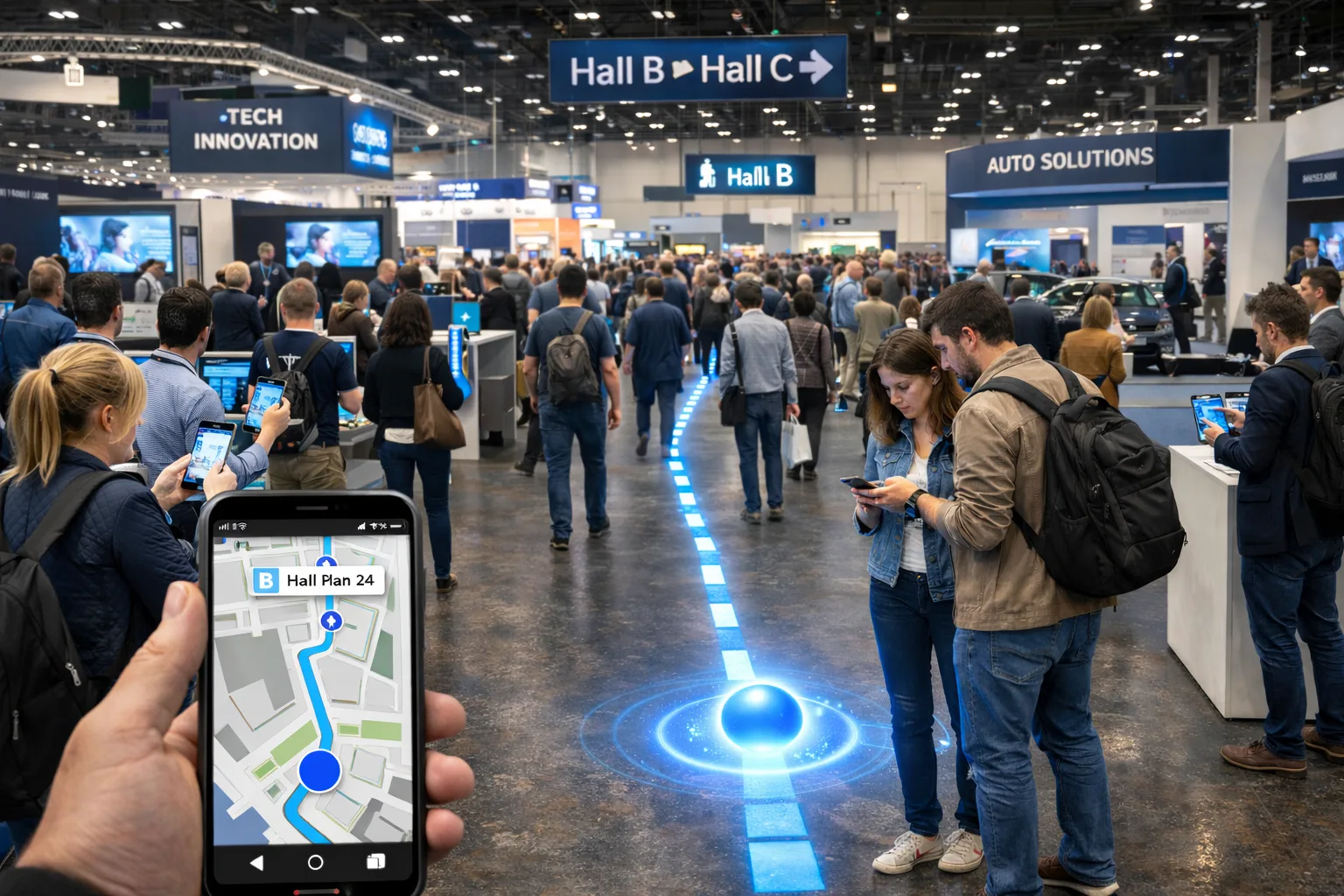
Indoor Navigation for Events —
Without the Guesswork
Indoor navigation makes movement easier, reduces confusion and helps attendees find the right place without asking for directions.
Key features
Interactive floor plans
We turn complex venue layouts into maps people can actually use under pressure.
Clear directions in seconds
Attendees search for a room, stand or feature and get a direct route right away.
Less time getting lost
People move between key moments without wandering around a busy venue.
Easier to discover
Sponsors and stands become easier to find which helps drive more relevant traffic.
Good navigation changes how people experience the whole event.
At large events people can lose time fast. They miss sessions, walk past the right room or stop staff for help every few minutes. Indoor navigation removes that friction quietly in the background.
When people know where they are going they feel more relaxed, more in control and more likely to explore the event fully. That helps attendees, exhibitors and organisers all at once.
The technology itself should be invisible. What matters is that people stop wandering around looking lost and start arriving at the right place on time. That shift sounds small but it creates better experiences across the board, from attendee satisfaction to exhibitor engagement.
Better attendee experience
Visitors can move through the venue with less stress and more confidence.
Less strain on your team
Staff spend less time repeating directions and more time helping where it actually counts.
Stronger venue flow
Movement across stages, rooms and exhibitor areas feels more natural and less chaotic.
A practical layer that makes the venue easier to use
Indoor navigation works best when it feels simple. It should reduce questions, improve confidence and help people spend more time engaging with the event rather than figuring out where to go next. The real value comes from how much smoother everything feels, not from the fact that someone used a map.
Searchable destinations
Rooms, stands, service desks and key spaces become easier to locate inside one joined-up experience.
Attendees can search by exhibitor name, session title or room number and get clear directions straight away. That reduces the need to stand around looking for signs or interrupting busy staff.
Improved sponsor visibility
Exhibitors benefit when people can actually find them instead of giving up halfway through the hall.
Sponsors often pay good money for floor space. Navigation makes sure people can locate them easily, which drives more traffic to stands and helps justify the investment in the event.
Fewer missed moments
Attendees are less likely to miss talks, meetings or key activations because they took a wrong turn.
When someone arrives late or misses a session entirely it affects the overall experience. Navigation reduces those frustrations and helps people get the full value from the event they paid to attend.
Indoor navigation works best
when nobody has to think about it.
That is the real goal. Not flashy technology for its own sake. Just a smoother experience for attendees, a calmer environment for staff and a venue that feels easier to move through from the moment people arrive.
We turn complex layouts into working maps
Large venues often have confusing floor plans, multiple buildings and inconsistent signage. We create digital maps that reflect the real layout and make it searchable for attendees.
This includes marking key locations like entrances, stages, catering areas, restrooms and exhibitor zones so people can find what they need without wandering around lost.
We connect destinations with clear directions
Once the map is ready we set up routing so attendees can search for a room or stand and get step-by-step guidance to get there.
Routes can factor in live updates, accessibility needs or traffic flow so people are always getting the most relevant path based on the current situation at the venue.
We link navigation to your event app
Navigation should sit naturally inside the tools attendees are already using. We connect it to your event app or digital platform so people do not need to switch between different systems.
This means someone can tap on a session in the agenda and immediately get directions to that room without leaving the app or searching manually.
We make sure it runs smoothly during the event
Technology can fail under pressure. We provide onsite support to monitor performance, fix issues quickly and update maps if layouts change at the last minute.
Our team stays available throughout the event to handle any problems and make sure navigation continues working without interrupting the attendee experience.
Crowd Connected — the indoor positioning system we deploy
Crowd Connected is one of Europe's leading indoor positioning platforms, used at some of the continent's largest trade shows, congresses and corporate events. It works via Bluetooth Low Energy beacons placed around the venue — no GPS, no dedicated hardware for attendees, no separate app download required.
How it works
BLE beacons triangulate attendee position in real time. The result is a "blue dot" on an interactive floor plan inside your existing event app — accurate to a few metres, even across multiple halls.
What we handle as deployment partner
Floor plan digitisation, beacon placement planning, physical installation, app integration, live monitoring during the event, and full breakdown. One contact for everything.
Compatible event app platforms
Crowd Connected integrates with Conference Compass, ExpoPlatform, Swapcard, Grip and others. We manage the technical integration so navigation appears inside the app your attendees already have.
Attendee analytics included
Beyond wayfinding, Crowd Connected captures anonymised footfall data — dwell time by zone, traffic heatmaps, peak flow periods. Useful for exhibitor reporting and future venue planning.
Which indoor positioning technology fits your event?
There is no single best system — the right choice depends on your venue, attendee count, app setup and what you want to do with the data. Here is how the main approaches compare.
BLE Beacons
What we useBluetooth Low Energy beacons placed around the venue triangulate attendee position via their smartphones. Accuracy of 3–5 metres, no extra hardware for attendees, works in multi-hall venues and integrates directly into event apps.
Best for: Trade shows, conferences, corporate events where attendees already use an event app. The dominant approach for events at scale in Europe.
UWB (Ultra-Wideband)
Sub-30 cm accuracy using dedicated tags worn by attendees or embedded in lanyards. Requires purpose-built infrastructure and hardware per person.
Best for: High-security or industrial environments where precise positioning matters more than ease of deployment. Rarely the right choice for public events.
Wi-Fi & RFID
Venue Wi-Fi access points or RFID readers at checkpoints can track aggregate flows or badge scans. Not suitable for real-time wayfinding — accuracy is typically 10–15 metres and requires dense AP coverage.
Best for: Aggregate analytics (session attendance, zone traffic) rather than individual navigation. Often used alongside BLE for richer data.
QR Codes & NFC
Static wayfinding using printed QR codes at key decision points. Low cost, no real-time tracking, entirely passive. Attendees scan to see where they are on a map.
Best for: Small venues or tight budgets. No analytics, no active routing — but still better than paper maps.
For most large-scale events, BLE is the right starting point — which is why we deploy Crowd Connected as our IPS platform of choice. Not sure which approach fits your event? We will tell you honestly — including when a simpler or cheaper solution is the right call.
How we've helped
Real examples from our work — shared without naming the clients.
Passive attendee tracking at an annual private conference
A financial services firm holds a large annual conference in Stockholm. VI handled the complete Crowd Connected setup with lanyard tags and operated the tracking system throughout the event. Attendees moved freely — no QR codes, no RFID arches.
Navigation at scale for a major European trade show
One of Europe's largest consumer electronics trade shows. VI ran the full operational scope: IPS deployment across multiple halls, local staff sourcing and coordination, location-based push message management, live reporting to organizers, and build-up and breakdown. One contact for the client — full control behind the scenes.
Indoor navigation for events — common questions
What is the best indoor navigation solution for events?
The best indoor navigation solution for events depends on venue size, exhibitor count and your attendee app setup. We work with Crowd Connected — one of the leading indoor positioning platforms used at major trade shows and conferences across Europe. As an official Crowd Connected deployment partner, we handle the full setup including floor plan mapping, beacon installation and integration with your event app.
How does indoor navigation work at trade shows?
Indoor navigation at trade shows uses Bluetooth beacons placed around the venue to triangulate attendee positions in real time. Attendees open the event app and see their location on an interactive floor plan. They can search for exhibitors, sessions or facilities and get turn-by-turn directions — without GPS, which does not work indoors.
Can indoor navigation be added to an existing event app?
Yes. Crowd Connected integrates with a wide range of event app platforms including Conference Compass, ExpoPlatform, Swapcard and Grip. We manage the technical setup so attendees get navigation within the app they already have — no separate download required.
How far in advance do I need to book indoor navigation?
For most events, six to eight weeks is enough lead time. For large trade shows with multiple halls, complex floor plans or integrations with an existing event app, we recommend starting the conversation three to four months ahead — particularly if beacon hardware needs to be ordered and shipped internationally.
Does indoor navigation work without attendees downloading a separate app?
Yes. When Crowd Connected is integrated into your existing event app, attendees simply open the app they already have. No QR code, no separate navigation download. For passive tracking scenarios such as analytics or lanyard-based positioning, attendees do not need to interact with the technology at all.
What is the difference between BLE, UWB and Wi-Fi indoor positioning?
BLE (Bluetooth Low Energy) beacons are the most practical choice for events: 3–5 metre accuracy, no dedicated hardware for attendees, and direct integration with event apps. UWB delivers sub-30 cm accuracy but requires hardware tags per person — rarely justified for public events. Wi-Fi positioning uses existing access points but accuracy is typically 10–15 metres, making it better suited for aggregate analytics than wayfinding. For most trade shows and conferences, BLE is the right starting point.
Often combined with
Services that teams typically use alongside this one.
Session Tracking
Automated session attendance on the same beacon infrastructure — no QR codes needed.
Event Apps
Indoor navigation integrates directly into the event app for a seamless attendee experience.
Managed Services
We manage the full technical setup including navigation deployment at your venue.
On-site Support
On-site staff to support navigation setup, exhibitor onboarding and live troubleshooting.
Related Case Studies
Indoor Navigation Deployment at a Large Trade Show
IPS-based indoor navigation deployed across a multi-hall trade show venue, guiding thousands of attendees.
Read case study → Case StudyPassive BLE Tracking at Life Sciences Congresses
Crowd Connected passive tracking deployed at a series of life sciences congresses to measure attendee movement.
Read case study →